

Renting a car in Scotland is one of the best ways to explore the country.
It lets you travel at your own pace, drive along scenic roads, stop wherever you want, and reach places you might never discover otherwise. That's why, whenever your trip allows for it, we 100% recommend it.
However, to make sure you have a great experience, there are several things to keep in mind before picking up the keys and starting your adventure.
Based on our experience, and to help everything go smoothly, here are our useful tips for renting a car in Scotland, along with a few things we've learned over the years.
Let's hit the road!
How to find a cheap rental car in Scotland
Our first tip is very simple: don't wait until you arrive in Scotland to look for a rental car.
Forget about arriving at the airport and then looking for a car rental company, because it will be much more expensive and not all vehicle types in their fleet may be available.
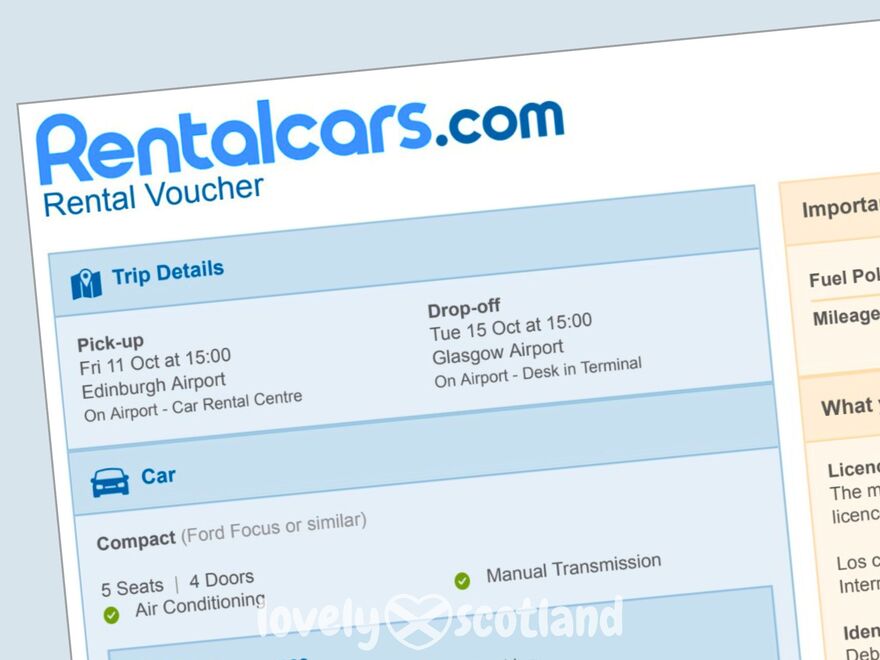
Before your trip, check the Rentalcars and Auto Europe websites in advance and compare prices.
These are the websites we use to book rental cars when we travel to Scotland (and anywhere else), and they are companies we trust completely.
Don't just look at the price displayed in large print. Always compare the final price of the reservation including all the extras you want to add (additional driver, automatic transmission, child seat...).
Once you've made your reservation, all you have to do when you arrive is find the rental company's counter, and you're all set.
What type of car is best for a road trip in Scotland?
For a road trip in Scotland, the type of car you rent will largely depend on your needs and personal preferences. Generally speaking, any car is suitable for traveling around Scotland.
Here are a few examples of the types of vehicles you can find and what each one is best for:
- COMPACT OR ECONOMY CAR, such as an Vauxhall Corsa or Renault Clio. Ideal if you want to save on fuel and easy to maneuver on Scotland's narrow, winding rural roads.
- FAMILY CAR - SUV, such as a Peugeot 2008 or Kia Sportage. A good choice for families. It offers more space and comfort, as well as better visibility.
- MINIVAN, such as a Citroën Grand C4 Spacetourer or even a Ford Transit Custom. If you're traveling with a large group and/or have a lot of luggage, a minivan is a good option. It offers plenty of interior space and comfort for all passengers.
- LUXURY CAR, such as a Mercedes E-Class or BMW 3 Series. For those looking for a more comfortable and stylish trip. Ideal for enjoying a relaxing drive through Scotland's landscapes.
Is an automatic car a better option?
This decision is worth giving a little more thought than usual if you've never driven on the left before.
In a manual car, the pedal layout is exactly the same as you're used to, but the gearshift will be on your left.
It's not difficult and you'll get used to it quickly, but during those first few miles you'll be paying attention to quite a few new things at once: staying on the left, entering roundabouts correctly, judging the car's position on the road...
That's why, if you're particularly concerned about driving on the left, renting an automatic car can make those first few miles much easier.
You'll only have to focus on the road.
If you want an automatic, make sure you select it specifically when booking and check that this feature is confirmed in the rental conditions.
What is it like to drive on the left?
Driving on the left for the first time can be quite a challenge, but as you gain confidence, you'll see that it's much easier than you think.
Here are a few tips and things to keep in mind to make the transition easier and safer:
Get familiar with the vehicle
The driver's seat is on the right-hand side. Make sure you adjust the mirrors and seat so you have good visibility.
The pedals are in the same positions (accelerator on the right, brake in the middle, and clutch on the left in manual cars), but the turn signal and windshield wiper controls may be reversed. Check this before setting off.
Changing gears
If you're driving a manual car, the gearshift will be on your left. The good news is that the shift pattern doesn't change, it's the same one you're already familiar with. Practice changing gears in a quiet area before heading into traffic.
Entering and leaving roads
In the UK, traffic moves clockwise around roundabouts. Yield to vehicles approaching from the right.
When turning at an intersection, remember to stay in the left lane. When turning left, be careful not to accidentally enter the right lane. And watch out for the curbs!

Lanes and passing
On roads with multiple lanes, the left lane is the slow lane and the lanes to the right are for passing. You only pass on the right. Make sure you have enough space and visibility before passing.
Passing Places
At some point during your road trip, probably along the NC500, you'll come across single-track roads with traffic traveling in both directions. Don't worry, they all have Passing Places, which are wider sections of the road where two vehicles can pass each other.
In this case, neither vehicle has priority, but it's just common sense to go through or let the other vehicle pass. Don't worry, you'll get the hang of it in no time.

Requirements for renting a car in Scotland
It's important to know the specific requirements to avoid any surprises. Each rental company will let you know what you'll need when you pick up the car.
These are the things you'll usually be asked for:
Driver's age
To rent a car in Scotland, you must be at least 25 years old. Some companies allow drivers between the ages of 21 and 24 to rent a car for an additional fee. Check the rental conditions.
International Driving Permit
You can rent a car in Scotland with your driver's license from your home country, so you don't need to apply for an International Driving Permit.
Bring your physical driver's license with you and make sure before you travel that it will remain valid throughout the entire rental period.
If you'd like to take a look, you can find this information on the UK government website.
Passport
Bring your passport with you, as you'll be asked for it when you pick up the vehicle.
Credit card in the driver's name
When you go to the rental company's counter to pick up the car, you'll be asked for a credit card - and be careful, not a debit card - in the main driver's name.
The company will place a hold on a certain amount as a security deposit, which will be released after you return the vehicle, it has been inspected, and everything is in order.
Don't rely solely on a virtual card or on the payment you made online beforehand. Paying for the reservation and having the required payment method when you pick up the car are two different things.
Types of rental car insurance
This is a very important topic, but it can also be long and tedious, so we'll keep it as simple as possible.
Of the available options, the best ones are all-inclusive coverage with no excess (the most convenient option, but also the most expensive) and insurance with an excess (Full Protection with Rentalcars and Full Damage Protection with breakdown coverage from Auto Europe).
Then, at the rental counter, they'll try to sell you even more comprehensive insurance, but it's usually much more expensive. Consider your options, but if you've chosen either of the two types of coverage above, you're already well covered.
The important thing is to know exactly what you've purchased, how much you could be financially responsible for if something happens, and which items are excluded from the coverage.
What is the excess?
The excess is the maximum amount you may be responsible for in the event of certain types of damage or theft covered under the rental agreement.
The lower the excess, the lower your financial exposure if something happens.
The excess and the deposit are not the same thing
This distinction is important.
The deposit or security deposit is an amount that the rental company temporarily retains, places a hold on, or charges to your card as a guarantee during the rental period.
The excess, on the other hand, determines how much you may have to pay for certain types of damage or theft depending on the coverage you've purchased.

Things to keep in mind when renting a car in Scotland
Mileage
One very important thing to check when renting a car is the mileage policy.
Make sure it includes unlimited mileage for greater peace of mind, as some rentals limit the number of miles you can drive, and if you exceed that limit, you'll be charged an extra fee for every additional mile.
Additional drivers
Most rental companies (if not all) charge an additional fee for each extra driver.
In some cases, it's a flat fee, while in others you need to look carefully, because what seems like a very low price can significantly increase the final cost, since these fees are often charged per additional driver, per day.
Keep this in mind before confirming your reservation.
Fuel policy
Our preferred option is usually "full-to-full." You receive the vehicle with a full tank and return it the same way.
Before returning the car, find a nearby gas station and fill up as needed. If you return it with less fuel than agreed, the rental company may charge you for the missing fuel and add a refueling fee according to its terms.
Keep the receipt from your last fuel stop until the rental is completely closed out.
Miles instead of kilometers
Both distances and speed limit signs are shown in miles rather than kilometers.
The car's odometer is in miles, so that's not a problem, and when it comes to distances, you just need to remember that 1 mile is equal to 1.6 kilometers.
Returning the car to a different location
If you want to pick up the car in Edinburgh, for example, and return it in Glasgow, check whether there is an additional fee for a one-way rental.
It can be a very convenient option for certain itineraries, but it doesn't always cost the same as returning the vehicle to the original rental location.

I've got the rental car, now what?
Great! All the paperwork is done, but before you set off, check a few things:
Check the car from top to bottom
If it has any dents or scratches, they should be noted on the sheet you're given along with a copy of the rental agreement. Even so, walk around the entire car and inspect everything carefully. Check the interior too.
If you find anything that isn't listed on the sheet, take photos. They'll be your proof when you return the car.
Sometimes they inspect the car when they hand it over to you. On a few occasions, we've found damage ourselves and reported it right away. They corrected the paperwork, and that was it.
Check the fuel tank
If the rental company's fuel policy is "full-to-full," check that the tank is full when you get in the car. If it isn't at 100%, check whether this is noted on the sheet they've given you.
You can also take a photo of the dashboard showing the fuel level, or let the staff know right away if they're still nearby.
Taking a photo costs nothing and can be very useful if any discrepancy comes up later.
And while we're talking about dashboard photos, it's also a good idea to make sure they show the car's mileage at both pickup and drop-off if you didn't choose unlimited mileage.

Our personal recommendations for driving in Scotland
Our first piece of advice is not to let the idea of driving on the left hold you back. Although it may feel intimidating at first, we can assure you that it's absolutely worth it, and you'll get used to it much faster than you think.
We recommend getting travel insurance. You'll be covered if anything unexpected happens, and if you need help, assistance is just a phone call away, wherever you are. Plus, you can get a 5% discount through our link.
Take a look at our 7-day Scotland road trip, where we tell you what to see and do, along with plenty of stops and details you won't want to miss.
Don't forget the documents you need to rent a car in Scotland: passport, driver's license, and a credit card in the main driver's name.
The essentials we always bring before setting off on a road trip are a phone mount and a car charger. They barely take up any space in your luggage and are especially useful if you use Google Maps for several hours.
Make sure you download maps of Scotland for offline use. There are plenty of areas with no cell service, especially on the islands and in the Highlands. Downloading them can save you a lot of trouble.
Don't try to plan overly ambitious routes. On a map, 100 miles may seem perfectly manageable. But on a Scottish road filled with incredible scenery, passing places, small villages, and places where you'll want to stop, it will probably take you much longer than expected.

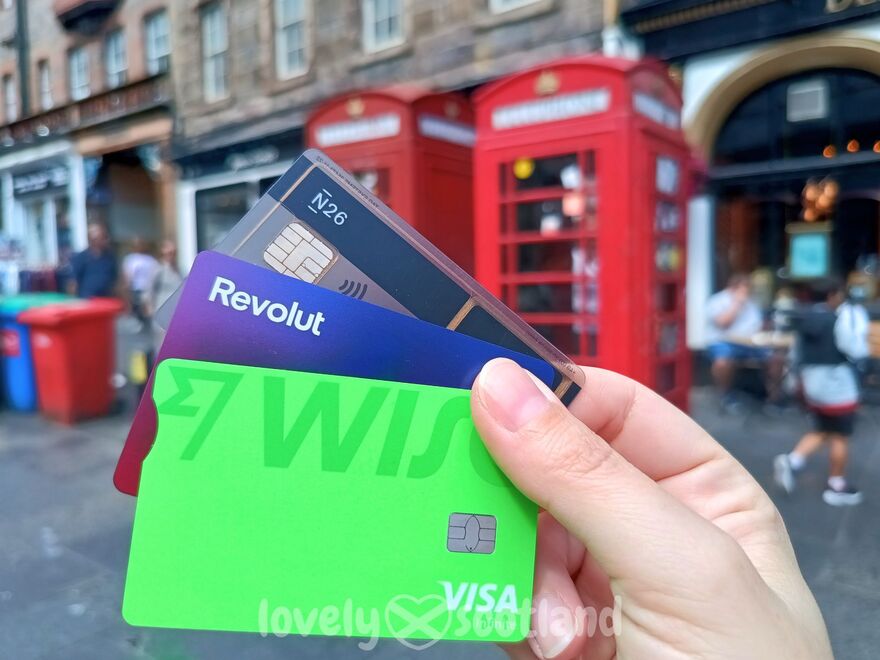
Bring some of these travel cards with no currency exchange fees. We use Revolut (physical and virtual), N26, and Wise, and they all work great for us.
Parking in Scotland is very easy, and you'll find parking lots at all the tourist attractions you visit. In busier cities, it's best to leave the car at the hotel and walk or use public transportation. Once you're outside the major cities, you shouldn't have any problems.
Be careful with roaming and your mobile carrier, as some carriers don't include free roaming. Get this unlimited data eSIM for the UK and travel without worrying about it.
And remember that in the UK you'll need Type G plug adapters.
We hope these car rental tips for Scotland help you understand the most important things to consider so you can avoid any surprises.
Enjoy the experience of driving through Scotland's magical landscapes!